The way people discover information online is shifting quickly. Your website is no longer viewed only by the people who land on it. It is also read, summarized, and judged by search engines and by AI tools such as ChatGPT, Google Gemini, and Perplexity. These systems influence what information is recommended and which websites get visibility. Because of this, your website now needs to communicate clearly to both humans and artificial intelligence.
To stay competitive, your site must appeal to three groups at the same time: your real visitors, traditional search engines, and large language models. Each one interprets content differently, and the sites that succeed going forward will be the ones that present clear, organized, trustworthy information.
Create Clear, Human-Centered Content
Your primary focus should always be the people arriving on your site. Visitors should immediately understand what you offer, who you serve, and how to take the next step. Simple, conversational language helps users feel confident and also helps AI systems interpret your content correctly. Complicated or vague writing makes it harder for both humans and machines to understand your purpose.
Organize Your Content in a Way AI Can Understand
Large language models read your site differently than humans. They rely heavily on structure, consistency, and clarity. When your page is organized with proper headings and distinct sections, AI can instantly grasp the topic. Clean paragraphs, descriptive headers, and full sentences make your pages easier for AI to summarize and categorize. When your content is structured well, it becomes more likely to be referenced or recommended by AI tools.
Keep Each Page Focused on One Topic
A website performs better when each page has a clear and singular purpose. A page about a service should talk only about that service. A page about a product should stay centered on that product. Search engines and AI tools both prefer focused, high-quality content. When a single page tries to cover too many unrelated topics, it becomes harder for machines to determine what it should rank for, and harder for visitors to understand.
Design for Speed, Simplicity, and Accessibility
A clean, fast, user-friendly website builds trust. Visitors quickly abandon sites that are slow or cluttered. Search engines also consider speed and mobile performance when deciding how high to rank your pages. AI tools look for websites that demonstrate reliability and professionalism. A site that loads quickly, functions well on phones, and uses clear navigation signals to appeal to every audience.
Use Metadata and Structured Information
Metadata is behind-the-scenes information that describes your content to search engines and AI. Clear page titles, accurate meta descriptions, meaningful alt tags for images, and structured schema markup help machines understand what your content is about. The clearer your metadata, the more accurately your site will appear in both search results and AI-generated answers.
Build Authority Through Expertise and Helpful Content
AI tools prefer recommending content from websites that show depth and expertise. You build this authority by sharing helpful articles, guides, resources, and explanations related to your field. High-value content shows both visitors and AI systems that your business is knowledgeable and trustworthy. When your site consistently provides helpful information, it becomes more likely to be referenced or recommended when someone asks an AI tool about your industry.
Keep Your Website Updated and Relevant
Fresh, current content matters. AI tools and search engines both pay attention to how often a site is updated. Outdated content is less likely to be trusted or recommended. Even small updates, such as refreshing service descriptions or adding a new section of information, signal that your business is active. Regular updates help maintain visibility and strengthen your credibility.
Strengthen Internal Linking and Site Navigation
Internal links help visitors discover related content and make it easier for AI tools to understand how your pages connect. A well-linked site gives both humans and machines a clear path through your content. Strong navigation and internal linking also help establish the structure and hierarchy of your information, improving indexing and interpretation.
Communicate Trust and Credibility
Trust is a major factor for users, search engines, and AI systems. A site that clearly displays contact information, an About page, policies, and transparent business details is seen as more legitimate. Testimonials, certifications, and clear service descriptions also help build trust. The more credible your site appears, the more likely it is to be ranked well and recommended.
Use a Platform Designed for Clarity and Performance
The platform you build your site on plays a large role in how well it performs. Modern, structured, stable platforms make it easier to maintain fast load times, mobile responsiveness, accessibility, and consistent organization. A clean platform gives both visitors and AI tools a better experience and sets your site up for long-term visibility.
Final Thoughts
Optimizing your website today means thinking beyond traditional SEO. It means creating content that is understandable, helpful, and trustworthy for both people and AI. When your site is organized, updated, clear, and built with intention, it stands out across search engines and AI tools. The future of website visibility belongs to businesses that communicate effectively to humans and machines alike.
While a beautiful design and engaging content are essential, the underlying structure of your website is what truly determines how well it performs—both in terms of user experience and search engine rankings. As a leading NH web design company, SunnValley knows firsthand how thoughtfully organizing your website structure can be a game-changer for your business’s online success.
Understanding Website Structure
Website structure refers to the way your website’s pages and content are organized and linked together. Think of it as the blueprint or roadmap of your site. A well-planned structure allows visitors to navigate your site easily, finding what they need without frustration. At the same time, it enables search engines like Google to crawl and index your content effectively, helping your site rank higher in search results.
According to experts at Yoast, a clear and logical site structure benefits both users and search engines by making navigation intuitive and ensuring that search engines understand how your content relates to one another. This foundational aspect of website design supports better visibility, usability, and ultimately, business growth.
How Website Structure Enhances User Experience
User experience is crucial for turning visitors into customers. When a website’s structure is clear, visitors can easily find the information they’re looking for without unnecessary clicks or confusion. This seamless navigation keeps users engaged, reduces frustration, and encourages them to explore more of your content or services.
At SunnValley, an NH web design company committed to quality, we always prioritize creating simple yet effective navigation menus and organizing content logically. This focus on usability means visitors spend more time on your site, increasing the chances they will take action, whether that’s making a purchase, filling out a contact form, or subscribing to a newsletter.
The SEO Impact of a Strong Website Structure
Search engines don’t just look at individual pages in isolation; they analyze how pages connect and relate across your entire website. A strong, well-thought-out structure helps search engines understand which pages are the most important, how content clusters together, and what topics your site covers.
According to Yoast, a good site structure prevents your own pages from competing against each other in search rankings—a common issue called keyword cannibalization. It also ensures that outdated or less relevant pages don’t rank instead of your current content. By making your site easier to crawl and index, you improve its visibility and performance in search engine results.
Planning for Growth and Scalability
Your business is always evolving, and your website needs to keep pace. A solid website structure makes it easier to add new pages, blog posts, products, or services without causing confusion or disorganization. This scalability allows your website to grow with your business while maintaining an excellent user experience and SEO performance.
SunnValley designs websites with an eye toward future growth, ensuring the architecture can expand smoothly and handle additional content effortlessly. This foresight means your website remains an effective tool for years to come.
Simplifying Website Maintenance
Maintaining a website is an ongoing process that involves updating content, fixing broken links, and ensuring everything functions properly. When your website has a clear, logical structure, these tasks become much easier and less time-consuming.
Yoast emphasizes that a well-structured website reduces the chances of errors or lost pages during updates, making maintenance more straightforward and less risky. SunnValley’s clients benefit from this thoughtful approach, with websites built for easy management and long-term success.
Essential Elements of a Good Website Structure
At the core of every well-structured website is a clear hierarchy that guides visitors naturally from broad topics to more specific content. The homepage serves as the central hub, directing users to main categories and subcategories before leading them to individual pages and posts. This hierarchy not only helps users find what they need but also signals to search engines how content is related.
Intuitive navigation menus, breadcrumbs, and internal links support this structure by helping visitors move smoothly between related content. Internal links within the text connect relevant pages, encouraging users to explore and spend more time on your site, while also helping search engines better understand your content’s context.
Another key factor is ensuring your website is mobile-friendly. With more people browsing on smartphones and tablets, your site must adapt seamlessly to different screen sizes. A responsive design improves usability and is favored by search engines, contributing to better rankings.
SunnValley’s Commitment to Effective Website Structure
At SunnValley, we specialize in building websites that combine attractive design with strategic structure tailored to your unique business needs. We customize your site’s architecture to align with your goals and audience, ensuring every visitor has a positive experience.
Our team integrates SEO best practices into every project, optimizing URL structures, internal linking, and navigation for maximum search engine visibility. We also build responsive, mobile-friendly designs so your website shines on every device.
Beyond launch, SunnValley offers ongoing support and maintenance to keep your site secure, up-to-date, and performing at its best. As your trusted NH web design company, we’re dedicated to helping your website grow with your business and adapt to changing needs.
Final Thoughts
A well-structured website is foundational to online success. It improves user experience, boosts SEO, supports future growth, and simplifies maintenance. If you’re a New Hampshire business ready to take your website to the next level, partnering with SunnValley ensures you get the perfect blend of custom web design and strategy.
Your website can be more than just a digital brochure — it can be a powerful tool that attracts visitors, builds trust, and converts leads into customers. Reach out to SunnValley today to learn how we can build a website structure that sets you up for long-term success.
When someone looks up your business, what do they see—especially on their phone? These days, mobile-first web design isn’t just a buzzword. It’s essential.
Over 60% of all website traffic comes from mobile devices. That means more than half of your potential customers or clients are seeing your site on a phone. And if your website isn’t built to work well on that smaller screen, you’re likely losing them—before they ever give you a chance.
At SunnValley, a professional NH web design company, we specialize in modern websites that look great, load fast, and are designed to work perfectly on mobile. Whether you’re a town office, contractor, or local business owner, understanding how mobile-first web design works—and why it matters—can help you make smart choices about your online presence.
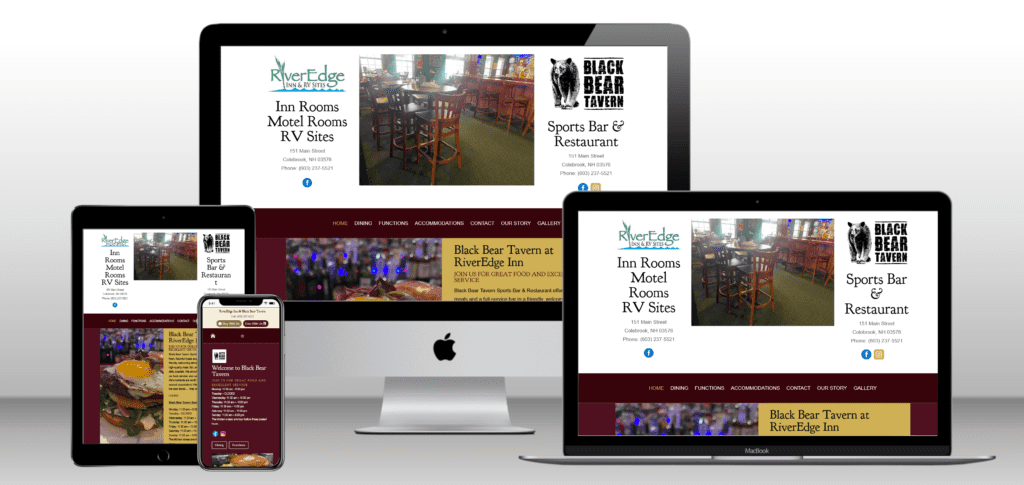
Black Bear Tav Website Redesign
What Is Mobile-First Web Design?
Mobile-first custom web design is an approach where we design for smaller screens first (like smartphones), then expand the layout for tablets and desktops. It flips the traditional design process. Instead of starting with a large desktop layout and squeezing it into a mobile version later, we focus on the most important features and user needs from the start.
Why does that matter? Because when a site is built for desktop and then shrunk down, it often becomes cluttered, hard to navigate, or frustrating on a phone. Designing mobile-first keeps everything clean, simple, and focused.
Mobile-First Is Now the Standard
Google now ranks websites based on their mobile version. This is called mobile-first indexing, and it means your mobile site is the version that Google uses to judge how your site performs in search engine results.
Studies show that 88% of users are less likely to return to a site after a bad mobile experience. And 57% of users say they won’t recommend a business with a poorly designed mobile site. Those are huge numbers. Your website isn’t just a digital business card anymore—it’s your reputation.
For a small business or town in New Hampshire, where people often search on the go, having a mobile-optimized site could be the difference between a new customer and a missed opportunity.
What Are UX and UI—and Why Do They Matter?
When we talk about building a modern website, we also focus on UX and UI. These two elements go hand in hand with mobile-first, professional web design.
UX stands for User Experience. This is how someone feels while using your site. Is it easy to navigate? Can they quickly find what they need? Does the site load fast? A great UX design keeps visitors engaged and happy. On mobile, this is especially important—because people are in a hurry.
UI stands for User Interface. This is how your website looks and responds. It includes things like layout, color schemes, typography, buttons, icons, and interactive features. Good UI makes your website attractive and usable, while bad UI creates confusion and frustration.
At SunnValley, our web design projects combine clean UI with thoughtful UX—especially when we’re designing for mobile-first.
Outdated styles that don’t reflect your brand today
In the past few years, we’ve helped many businesses and town offices across New Hampshire update their websites from outdated, desktop-only versions to modern, mobile-first designs. The result is always a faster, more user-friendly site that performs better in search results and builds more trust with visitors.
Why Redesigning Your Website Makes Sense
If your site feels outdated, hard to navigate, or slow on mobile, it’s time to consider a redesign. This doesn’t mean starting from scratch—it means improving what you already have with modern tools and a mobile-first approach.
A website redesign from SunnValley, your local NH web design agency, includes:
Mobile-first web design to prioritize speed and ease of use
Improved layout and navigation for better UX
Clean, modern visuals that reflect your brand
Built-in tools so you can easily manage your own updates
Optional add-ons like document libraries, calendars, and contact forms
Whether you’re running a business or managing a town website, an updated site will help you better serve your visitors and grow your reach.
What If You’re Just Getting Started?
Launching a new business or project? Now’s the perfect time to do it right from the beginning. A mobile-first website gives you a solid foundation that can grow with your needs.
You don’t need to be tech-savvy. We’ll walk you through the entire process and deliver a website that’s not only beautiful, but also easy to use and maintain.
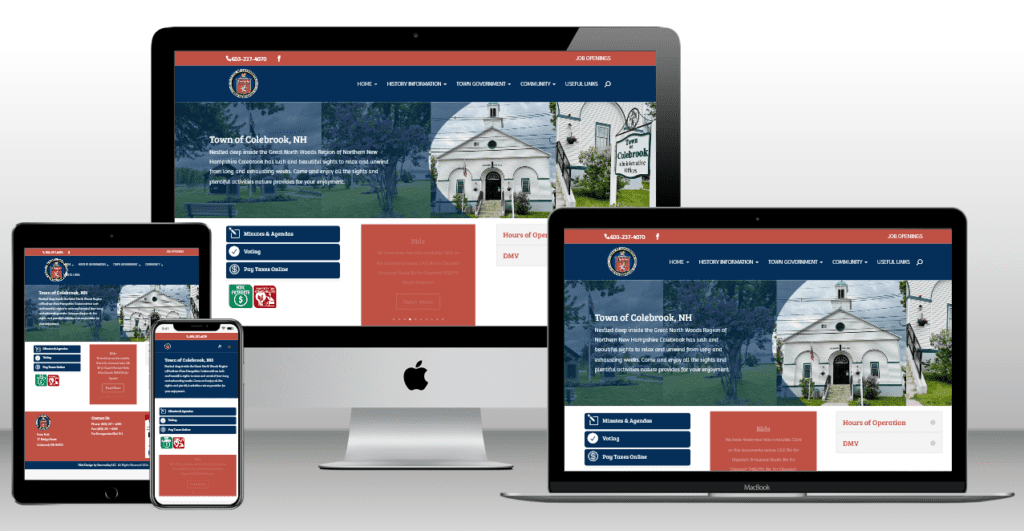
We’ve helped towns like Colebrook, Columbia, and Stratford NH upgrade their web presence with mobile-first design and organized content management. We’ve also worked with local contractors, retail shops, photographers, and startups to build effective, easy-to-navigate websites from the ground up.
Let’s Talk About Your Website
Your website is often the first impression someone gets of your business or organization. If it’s outdated or hard to use on a phone, it could be doing more harm than good.
That’s where we come in. At SunnValley, we specialize in nh web design that prioritizes mobile-first strategies, strong UX and UI design, and clean, modern visuals that connect with your audience. Whether you’re upgrading an old site or starting fresh, we make the process easy, affordable, and stress-free.
Website accessibility means designing and developing your site so that people with disabilities can use it easily. This includes those with visual, auditory, cognitive, or motor impairments. Making your website accessible improves user experience, broadens your audience, and ensures compliance with legal standards. For businesses working with an NH web design company like SunnValley, accessibility is a critical part of delivering a professional, inclusive, and effective online presence.
Understanding Website Accessibility
Website accessibility is about removing barriers that prevent people from accessing or interacting with your website content. These barriers can be anything from images without descriptive text, videos without captions, confusing navigation, to websites that don’t support keyboard use. When a website lacks accessibility, it can exclude a significant portion of potential visitors—approximately 15% of the global population lives with some form of disability.
In addition to serving all users fairly, accessible websites tend to perform better overall. They often load faster, are easier to navigate, and have clearer content structures—all factors that also boost search engine optimization (SEO). This makes accessibility a win-win for both users and businesses.
The Importance of Testing Your Website for Accessibility
Many businesses assume their website is accessible without actually testing it. However, accessibility testing is a crucial step to identify and fix issues that might be invisible to most users but create major obstacles for those relying on assistive technologies.
At SunnValley, an experienced New Hampshire custom web design agency, we offer comprehensive website accessibility testing as part of our service. This includes both automated tools and manual reviews to ensure your site meets current accessibility standards, such as the Web Content Accessibility Guidelines (WCAG). Testing allows you to:
Identify missing alt text for images
Check if your website can be navigated via keyboard alone
Evaluate color contrast to ensure readability
Confirm that multimedia content includes captions or transcripts
Review the clarity and structure of forms and interactive elements
Regular accessibility testing is essential because web technologies evolve, and content changes over time. What was accessible last year may no longer meet today’s standards.
Why Older Websites Should Be Updated for Accessibility
Many older websites were built before accessibility became a widespread priority. As a result, they often contain barriers that make it difficult or impossible for people with disabilities to use them. These issues not only exclude users but can also put your business at legal risk.
Updating an older website to meet accessibility standards is an investment in your brand’s future. It sends a strong message that your business values inclusion and customer experience. Moreover, an accessible site improves overall usability, benefiting all visitors regardless of ability.
A New Hampshire web design company like SunnValley specializes in modernizing websites to be fully accessible. This includes revisiting design elements, rewriting image labels, restructuring navigation, and ensuring compatibility with assistive devices.
In my opinion, some websites require an in-depth redesign focused specifically on accessibility, while others may only need minor updates to meet standards. Community websites are especially important in this regard because they serve diverse groups of people, including many who depend on accessible technology to participate fully. Ensuring these sites are inclusive is not just beneficial—it’s essential for fostering engagement and communication within the community.
The Business Benefits of Accessibility
Beyond ethical and legal reasons, there are clear business advantages to having an accessible website:
Expanded Audience Reach: Making your site usable by everyone opens your doors to a broader customer base.
Improved SEO: Search engines favor websites with clear structure and descriptive content, both hallmarks of accessibility.
Better User Experience: Accessible websites are often easier to navigate and understand, keeping visitors engaged longer.
Brand Reputation: Demonstrating commitment to inclusion builds trust and loyalty among customers.
Legal Protection: Staying compliant with accessibility laws reduces the risk of costly lawsuits or penalties.
These benefits highlight why accessibility should be a key part of your web strategy.
How SunnValley Supports Accessibility for Your Website
At SunnValley, we understand that website accessibility is not just about meeting minimum requirements—it’s about creating a welcoming, usable environment for every visitor. When you work with us, you get:
Accessibility Testing: We test your website thoroughly using both tools and manual checks to find and fix barriers.
Ongoing Support: Accessibility is an ongoing effort. We help maintain and update your site to stay compliant as standards evolve.
Training and Resources: For active customers, we provide guidance on how to keep your content accessible, including image recommendations and labeling best practices through our customer portal.
Website Redesigns: For outdated sites, we offer modern redesigns focused on accessibility, usability, and performance.
By partnering with a dedicated New Hampshire web design agency like SunnValley, you ensure your website works well for everyone now and in the future.
Conclusion
Website accessibility is essential for creating an inclusive digital presence that meets the needs of all users. Whether you are launching a new site or updating an older one, testing and optimizing for accessibility should be a top priority. Accessible websites deliver better user experiences, improved SEO, and expanded reach, all while protecting your business legally.
If you’re ready to evaluate your website’s accessibility or want to bring an older site up to today’s standards, SunnValley is here to help. As a trusted NH web design company, we provide expert testing, redesign, and ongoing support to make your website welcoming and effective for everyone.
Contact SunnValley today to learn how our New Hampshire web design agency can improve your site’s accessibility and help your business succeed online.
Website images are a powerful element of website design and can affect your website’s search engine results! Your images can capture attention, communicate your brand’s story, and enhance the overall user experience. Without proper sizing and labeling, images can negatively impact your website’s performance, SEO, and accessibility. For businesses working with an NH web design company like SunnValley, understanding these details is essential to building a website that performs well and represents your brand professionally.
Pioneer Farm Education Center website design by SunnValley LLC, Columbia, NH
Why Proper Image Size Matters
Choosing the right image size is critical for website speed and appearance. Large images with high resolution can look impressive, but often slow down your site’s loading time. Since visitors expect fast-loading pages, delays can increase bounce rates and reduce conversions. Moreover, slow websites tend to rank lower on search engines, making it harder for potential customers to find you.
On the other hand, images that are too small or compressed too much can appear blurry or pixelated, which hurts your brand’s credibility. Properly sized images strike a balance—they maintain clarity and sharpness while loading quickly on all devices, from desktops to smartphones.
A New Hampshire custom web design agency like SunnValley focuses on optimizing every image on your site to ensure it looks great and loads fast, delivering the best experience to your visitors.
The Role of Image Labeling in SEO and Accessibility
Proper image labeling includes descriptive file names and alternative text (alt text). These elements help search engines understand your images, improving your website’s SEO. Search engines cannot interpret images visually; they rely on labels to index content correctly. Well-labeled images increase your chances of appearing in search results and image searches.
Alt text also plays a vital role in accessibility. It describes images to users who rely on screen readers, such as people with visual impairments. Without accurate alt text, these users miss important information, making your site less inclusive. Additionally, proper labeling helps your site comply with accessibility standards and legal requirements.
At SunnValley, we ensure that all images are labeled thoughtfully to enhance SEO and provide an inclusive experience for all users.
How SunnValley Supports You with Website Image Recommendations
When you become an active customer of SunnValley, you gain access to a dedicated customer portal that includes comprehensive image recommendations. These guidelines cover:
Ideal image dimensions to balance quality and load speed
Best practices for naming files with clear, descriptive terms
Tips for writing effective alt text that improves both SEO and accessibility
Our team also reviews your existing images and offers personalized advice to optimize them. This helps avoid common issues that could slow down your website or hurt its search rankings.
The Broader Impact of Optimized Website Images
Optimizing image size and labeling doesn’t just affect technical aspects—it also improves user experience and strengthens your brand. Fast-loading, sharp images keep visitors engaged and encourage them to explore your content. Clear, professional visuals build trust, making users more likely to become customers.
Moreover, accessible images show that your business values all users and meets modern web standards. This commitment to quality and inclusivity can set you apart in today’s competitive online market.
Conclusion
Proper image size and labeling are foundational to creating a website that looks professional, performs well, and reaches a broad audience. As a trusted NH web design company, SunnValley helps businesses in New Hampshire and beyond optimize their websites with expert guidance and practical tools. We offer free stock to our design clients. See our policy.
When you join SunnValley as an active customer, you benefit from our detailed image recommendations through our customer portal—ensuring your website’s images are perfectly sized, labeled, and optimized for speed, SEO, and accessibility.
Ready to build a website that works for your business? Contact SunnValley today to learn how our New Hampshire web design agency can help you get the most from your website’s images.
Websites age—just like fashion trends, hairstyles, and that stack of business cards you forgot you ordered. Even the best-designed site from a few years ago might feel a little tired or off-brand today. If you’ve been considering a website redesign or wondering whether your current website still holds up, you’re not alone—and you’re not overthinking it.
Maybe everything still works, technically speaking. But a functioning website isn’t the same as a thriving one. Your website should be doing the heavy lifting for your business: showing off your personality, making it easy to work with you, and attracting new customers like a magnet. If that’s not happening, it might be time for a refresh.
Let’s talk about what to look for.
Are Your Photos Outdated?
Photos are often the first impression people get of your brand. If your site still has that headshot from five haircuts ago, or product shots from a now-discontinued line, it’s time to refresh. Visuals should reflect who you are now—not who you were years ago.
Swapping out outdated images for fresh, high-quality photos can instantly modernize your site. And if you don’t have great photos yet, we’ve got you—SunnValley offers professional brand photography right here in New Hampshire, and we love helping businesses look their best online.
Is the Content Still Accurate?
It’s easy to let content go stale, especially when your business is busy growing. But if your site still lists services you no longer offer—or worse, doesn’t mention all the new ones you’ve added—then it’s not doing your business justice.
Check through your pages. Are your hours still right? Does your “About” section still reflect your mission or values? Is your pricing info current? Your content should feel like a conversation with the customer you want to reach today.
Have You Outgrown It?
If you’ve made big changes in your business—like adding consulting, coaching, or packaged services—your site should reflect that evolution. Maybe you’ve shifted your focus or stopped doing certain things altogether. That’s totally normal. Your website just needs to catch up.
Think of it like this: if someone new finds you online, will they get an accurate picture of what you offer right now? If not, it’s time to update or redesign.
Is It Mobile-Friendly?
Pull out your phone and visit your site. Does it look clean and easy to use? Or are you pinching, zooming, and squinting just to read the text?
More than half of your visitors are likely viewing your site on their phones. A site that works great on desktop but falls apart on mobile is a huge red flag. Google doesn’t love it either—and if your search ranking has dropped lately, this could be part of the reason why.
Is It Easy to Navigate?
Think of your website like a digital storefront. If people can’t figure out where to go, they’re not going to stick around.
A confusing layout or cluttered menu is frustrating, and your visitors will bounce fast if they can’t find what they’re looking for. If you’ve ever heard someone say, “I couldn’t figure out how to contact you on your site,” take that as a clear sign it needs some TLC.
A good website guides visitors effortlessly to the next step—whether that’s learning more about you, viewing your services, or getting in touch.
Does Your Story Still Resonate?
Your “About” or “Our Story” page matters more than you might think. People want to work with businesses that feel human and relatable. A dry, outdated bio doesn’t do much for connection—or conversions.
If your story’s evolved or you’ve honed in on a stronger sense of purpose, now’s the time to reflect that on your website. Keep it warm, real, and relevant. This is your chance to build trust before a client even reaches out.
Is the Design Feeling a Little… Meh?
Design trends change fast. What looked sleek a few years ago might now feel clunky or off-brand. Maybe the fonts are a little too whimsical, or the colors don’t match your updated branding.
Even small tweaks to design—like cleaner fonts, updated color schemes, and fresh layout spacing—can breathe life into a tired website. You don’t always need to start from scratch, but if the site feels “meh,” trust that gut feeling.
Is the Website Doing Its Job?
At the end of the day, your site should be working. That means bringing in leads, selling your products, scheduling appointments—whatever success looks like for your business.
If traffic is up but you’re not getting any new inquiries or sales, the issue might be the messaging, layout, or lack of clear calls to action. Your website isn’t just a digital brochure—it’s your best salesperson. Make sure it’s performing like one.
What’s the Vibe?
Finally, step back and ask yourself one big-picture question: does my website still feel like me?
If your business has grown, shifted, or simply matured, your site should reflect that. You deserve a space online that feels current, on-brand, and true to the experience you offer.
Where SunnValley Comes In
Here at SunnValley, we help small businesses, towns, and professionals create websites that actually feel good to use and reflect what makes them unique. Whether you need a full redesign, new content, or updated photography, we can help get your website in shape and aligned with your goals.
We also offer professional photography (because no one should rely on blurry phone pics in 2025) and specialize in websites that are mobile-friendly, super easy to update, and built with your audience in mind.
Let’s Wrap This Up
Your website doesn’t have to be perfect—it just has to work for where your business is today. If it’s no longer doing that, a refresh might be exactly what you need.
Still unsure? We can take a peek and let you know what’s working, what’s not, and what could be improved. No pressure—just honest feedback from a team that gets it.